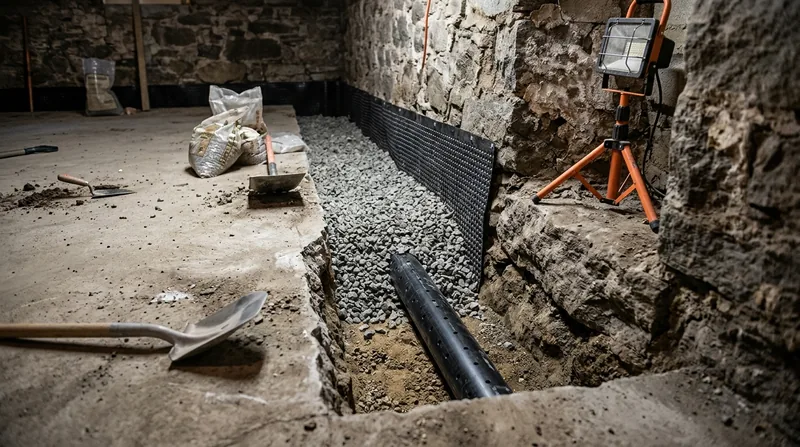




If you own one of the 1890s to 1930s wood-frame houses in Campello or Montello, your cellar was dug by hand into glacial outwash sand and gravel over dense till, and the water table in the low streets near the rail line stays high through every wet season. That is exactly the ground where an Interior Drain Tile System in Brockton earns its keep. We cut a channel along the inside of the footing, lay perforated pipe in washed stone, and carry the water to a sump basin that pumps it out and away from the foundation. It works in any season, which matters here because nor'easters, heavy autumn rain, and spring snowmelt all push water against old fieldstone and early block walls. If you are tired of a wet basement after every storm, start with a free basement inspection so we can see what the footing is actually doing.
Why Brockton Cellars Flood and Why Interior Drain Tile Fits This Ground
Brockton sits on glacial outwash sand and gravel capped by a dense till layer, with clay pockets in the low streets. Water percolates fast through the sand until it hits the till, then it spreads sideways and rises against the footing. In the old shoe-factory side streets, that means a full cellar of fieldstone or early brick walls weeping at the mortar joints every time the water table climbs.
- Fieldstone and early brick walls in Campello and Montello leak at the mortar because the original parging has failed.
- Poured-concrete basements in the 1960s to 2000s ranches and colonials on the outer streets crack at the cold joint and seep under hydrostatic pressure.
- Clay pockets in the low streets hold water against the foundation long after the rain stops.
- Freeze-thaw cycles widen existing cracks and pop off old parging through the winter.
An interior perimeter drain captures that water at the footing before it ever reaches the floor, which is why it outperforms repeated crack sealing when the problem is the water table rather than a single defect.
Key info: On a block of 1920s two-families off Montello Street, the floor stayed wet for three days after every autumn storm. The footing drain had collapsed decades earlier. We installed an interior perimeter drain and a new sump basin, and the floor has stayed dry through two spring snowmelts since.
How We Install an Interior Drain Tile System in Brockton
We start by walking the basement and checking the footing depth, wall type, and floor slab thickness. On a fieldstone cellar we may need to underpin the wall base as we open the channel. On a poured-concrete basement in Westgate or the downtown edges, the cut is cleaner and faster. Either way, the sequence is the same, and we keep the work area contained so the rest of the house stays usable.
- We mark the perimeter and cut a channel along the inside face of the footing, about 12 inches wide.
- We remove the spoil and inspect the footing for soft mortar, crumbling block, or a failed original drain tile.
- We lay washed stone, set perforated pipe with the holes down, and slope it to the sump basin.
- We set the sump basin at the low point and connect the discharge line to a freeze-protected outlet.
- We cover the stone with filter fabric and pour a new concrete channel cap flush with the floor.
- We test the system with water and confirm the pump cycles and the check valve holds.
Every installation ends with a wet test, because a drain tile system is only as good as its slope and its discharge.
Key info: A 1950s Cape Cod in Westgate had a partial basement that flooded from the cold joint every March. We cut the interior channel, tied in a new sump basin, and ran the discharge to a dry well 15 feet off the foundation. The homeowner has not seen standing water since. If your discharge line is the weak point, see our sump pump installation page.
Interior Drain Tile Methods Compared for Brockton Basements
Not every basement needs the same configuration. The right approach depends on wall type, footing condition, and how much water the ground actually delivers. Here is how the main options compare on Brockton building stock.
| Approach | Description | Best for |
|---|---|---|
| Full interior perimeter drain | Channel cut along the entire footing, pipe to sump basin, new concrete cap | High water table, wet floor across the whole basement |
| Partial interior drain | Drain along one or two wet walls, tied to a sump basin | Seepage limited to the uphill or street-facing wall |
| Drain tile repair and replacement | Replacing a collapsed or clogged original footing drain | Older homes where the original weeping tile has failed |
| Interior drain with vapor barrier | Drain plus dimple board or vapor barrier on the wall face | Damp walls and efflorescence above the drain line |
| Exterior excavation | Dig out the foundation, apply membrane, replace footing drain | Bowing walls or a footing that needs structural work |
On most Brockton basements, the interior system wins on cost and on year-round installability, and it leaves the exterior grade and plantings alone.
Interior Drain Tile System Cost in Brockton: What to Expect
Most interior drain tile work in Brockton starts around $50 per linear foot, and that figure covers the channel cut, washed stone, perforated pipe, filter fabric, and the new concrete cap. A full perimeter on a 30 by 40 foot basement runs about 140 linear feet, so the base number lands near $7,000 before the sump basin and pump. Fieldstone cellars in Campello often add cost because the wall base needs stabilizing as we open the channel.
Access matters too. A basement with a finished ceiling, a furnace in the corner, or a narrow bulkhead takes longer than an open cellar. A failed original footing drain that has to be cut out and replaced adds labor. We price the sump basin, pump, check valve, and discharge line separately so you can see exactly what each part costs.
Get two or three estimates and compare scope line by line, not just the bottom number. A quote that skips the sump basin or the concrete cap is not the same job. Our full pricing overview breaks down the components so you can read a competitor's bid with confidence.
Choosing a Waterproofing Contractor Near Brockton: What to Check
Waterproofing is a below-grade trade, and the wrong contractor can leave you with a channel that does not drain or a discharge line that freezes. Ask for the license and insurance certificate before anyone cuts concrete, and confirm the policy covers below-grade work. Call two recent references and ask whether the basement stayed dry through a spring snowmelt, not just through a dry summer.
Ask who pulls the permit. Work that alters drainage or the sanitary connection of a sump discharge commonly needs one, and thresholds vary by jurisdiction, so verify with the Brockton building department before work starts. Get the warranty terms in writing and confirm they are transferable. When you are ready to compare bids, contact us for a free estimate and we will walk the basement with you.
Interior Drain Tile System in Brockton: Pricing Guide
| Service | Price | Details |
|---|---|---|
| Interior perimeter drain (full basement) | Starting at $50/linear ft | Includes channel cut, washed stone, perforated pipe, filter fabric, and new concrete cap. |
| Partial interior drain (one or two walls) | Starting at $45/linear ft | Covers the wet walls only, tied to a sump basin at the low corner. |
| Sump basin and pump package | Starting at $1,200 | Basin, pump, check valve, and discharge line to a freeze-protected outlet. |
| Drain tile repair and replacement | On estimate | Collapsed or clogged original footing drain needs an on-site look before pricing. |
| Travel | Included | In Brockton and surrounding areas, no separate call-out or mileage fee. |
| Estimate | Free | Response within 24h at (774) 496-2966, no obligation to book. |
Indicative pricing, the exact cost depends on square footage, finish, and site access. Free personalized estimate within 24h at (774) 496-2966.


